Buzz Promotions That Survive Past Launch Week
Employee social sharing stalls when it is run as an occasional ask. Running buzz Promotions as a structured program with reminders, standings and rewards is what keeps posting alive past launch week.
A working buzz promotion has four parts: a prompt that reaches people on time, a visible standing, a reward tied to the standing, and a cadence that repeats. Miss any one and the program runs for about two weeks and then goes quiet. The reason is not enthusiasm. It is that the loop has no feedback path, so the people who share most get nothing back and the people in the middle have no reason to start.
Inside the Machine: The Four Parts of a Buzz Promotion
Picture the actual afternoon. A marketing lead copies a link into a chat thread, pastes a caption, and asks the team to share it. Six people do. Fourteen do not. Nobody, including the lead, can say who shared what or whether the six did it because they wanted to or because they happened to be online when the message landed.
That is the whole failure, and it is structural rather than personal. A structured program replaces the chat message with four parts that run against each other.
A prompt is the post itself: the link, the caption, the channel. It has to reach every participant at roughly the same moment, and it has to be short enough to act on without thinking. A prompt delivered once, in a thread that scrolls, reaches whoever is free that hour.
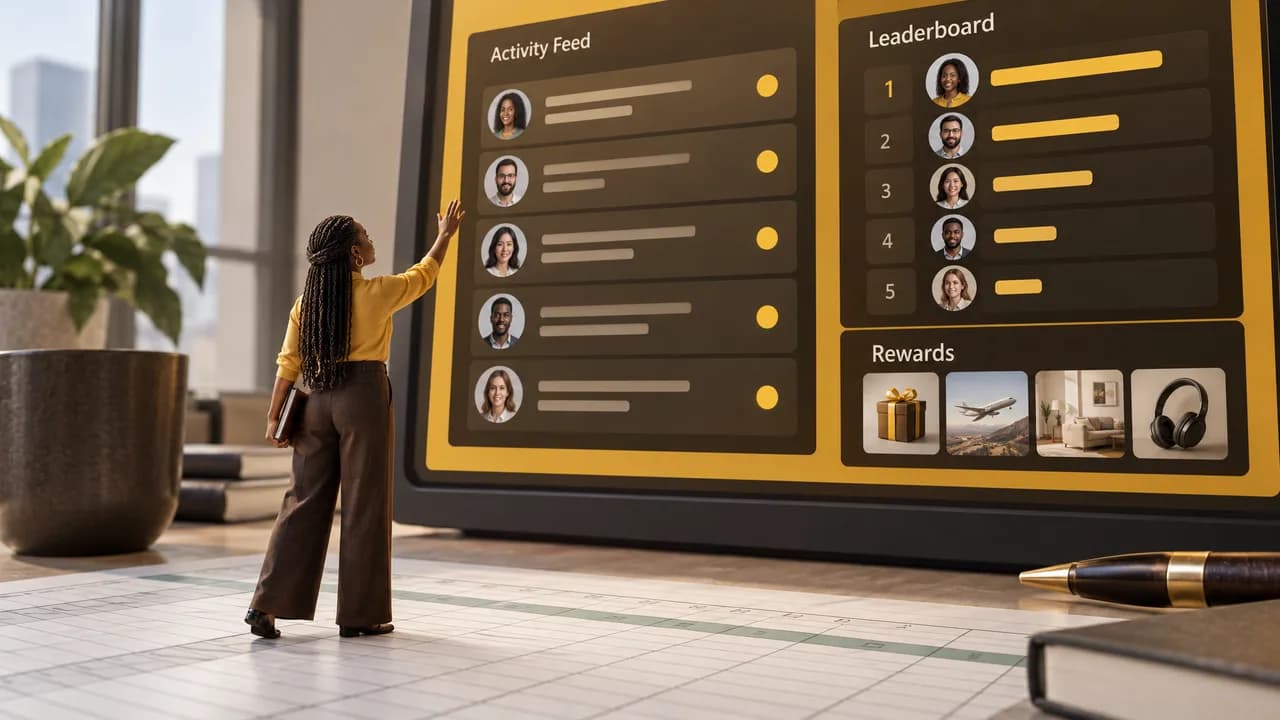
A standing is the visible record of who has done what. This is the part most teams skip, and skipping it is why the next part never works. A standing turns an invisible contribution into something the participant can check on their own time. A leaderboard wired to reminders and rewards is not decoration: it is the feedback channel that makes the rest of the loop close.
A reward is what a high standing converts into. Cash, gift cards, a prize contest, a lunch. The specific reward matters less than whether it arrives predictably and soon after the effort. Deferred recognition reads as no recognition.
A cadence is the schedule the other three run on. Daily prompts, a standing that updates in near real time, a reward cycle that closes on a known date. When any of these slips out of step with the others, the loop stalls in a way participants feel before the numbers show it.
Why Momentum Dies by Week Three
The usual instruction fails because the ask is built for the moment of launch. Someone builds excitement, sends the first three posts, and then goes back to their actual job. Three problems surface after that.
Nobody can tell whether they are ahead or behind. When sharing has no visible score, effort is unverifiable. A person who shared five times in a week sees no difference between that and sharing once, and the rational move is to share less. This is not laziness; it is a missing signal.
The prompting stops. A single send is an event. A program is a repeating one. Teams that run employee sharing on an occasional basis are, in practice, asking people to remember a task that lives outside their job description. The people who keep doing it after week two are the ones who were already sharing on their own, which means the program changed nothing.
The reward arrives too late or not at all. If the prize is announced for the end of the quarter, the connection between a Tuesday share and a December reward is too faint to influence behavior. A program has to close its reward cycle often enough that the last share is still fresh when the prize lands. Our own take on encouraging shares without nagging lands in the same place: chasing is a signal that the cadence has already broken.
Building a Program That Keeps Running
- Decide the single action you are rewarding. Sharing a post to a personal feed is a different action from commenting, and a different one again from creating original content. Pick one.
- Set the prompt cadence before you invite anyone. Daily prompts suit campaign windows; three a week suits always-on programs. Announce the cadence instead of asking people to guess it.
- Publish the standing from day one, before anyone has a score worth defending. An empty board that fills in publicly teaches the group that the numbers are real.
- Attach the reward to the standing, not to a manager's judgment. Favoritism is the fastest way to lose the middle of the group.
- Close the reward cycle on a fixed date and name the winner in the same channel the prompts run in.
- Review the standing weekly and treat flat weeks as a prompting problem before treating them as an attitude problem.
The order matters because step three does the heavy lifting. If the standings appear only after the program is already failing, they read as a corrective measure aimed at the people who did not participate.
The Failure Patterns That Kill Participation
Rewarding the same three people is a documented attrition pattern. When the top of the board never changes, everyone below it has zero expected return and stops competing. Why volunteer sharers quit and leaderboards hold covers the same dynamic: the people who leave first are the ones who never saw themselves in the standings. The fix is a ranking system that rewards the right work, not a bigger prize for whoever is already winning.
Running the program without a reminder mechanism produces a slow fade rather than a clean failure. Nobody complains. Participation just narrows to the group that shares anyway, and the metrics look stable because the same few people keep posting. This is the most expensive version of the mistake, because it looks like it is working.
Treating the promotion as a one-time campaign is a category error. A campaign has a start and an end and an audience outside the company. Employee sharing is a standing capability. A campaign framing guarantees the program ends at the campaign's date, and restarting it costs more attention than running it continuously would have.
Letting scores stay invisible causes quiet disengagement from the middle of the group. The top sharers do not need a leaderboard; they share regardless. The leaderboard exists for the person who would share twice a week if they knew it counted.
Collecting data the program does not act on is a trust problem. If you are tracking participation, say what the numbers are used for. Tracking without visible response teaches participants that their effort is being measured for someone else's benefit.
What the Available Data Covers, and What It Leaves Out
There is no clean public benchmark for employee sharing conversion, and the vendor pages that rank for this topic do not publish one either. What exists is mostly category-level, and the honest position is that measurement only pays off once the team shares, which means the useful data starts after the program is running rather than before.
The related event-marketing field does publish its own framing. Buzz Promotions positions itself as an all-in-one event staffing and experiential marketing source, and describes its own work as connecting brands with people through high-impact events and national campaigns. That is a different discipline with a different budget line, and the overlap with employee sharing is mostly the word. Its staffing model is custom staffing solutions delivered by local teams in major Canadian cities, which is a field-marketing capability rather than a software loop.
So the practical answer is to build your own baseline in the first month and compare against it. Record posts sent, posts actually shared, unique sharers, and new participants added week over week. Four numbers over four weeks tell you more about your program than any external benchmark would, because sharing rates depend on team size, industry, and how much of the team is on the social platforms you are asking them to use.
How Buzz 52 Runs the Loop
We built Buzz 52 because the four parts above are tedious to run by hand, and hand-run programs fail on the tedium rather than on the idea. We launched Buzz 52 to turn your team into a social media machine, and setup runs under five minutes. There is a live demo of a running program if you want to see what the standings and prompts look like before you commit.
We gamify employee engagement with leaderboards and rewards, so the standings that drive the sharing are the product, not a spreadsheet you maintain on the side. Automated reminders run on your custom send schedule, which is what keeps a daily program alive on a busy week. Live leaderboards and point tracking keep standings current instead of updating once a month. Prize contests send winner notifications automatically. Posts go out through the team's own accounts, with your company logo and branding on the program itself.
Pricing scales with team size rather than feature gates, so a ten-person team gets the same feature set as a two-hundred-person one. Free covers one to five employees, Standard covers six to forty-nine, and Enterprise covers fifty or more, priced per employee per month with the current number on our pricing page. We do not publish a rate card here because team size determines it.
The program is built for social media amplification, not for performance reviews, internal comms, or training. If you need a recognition platform with a global rewards marketplace, or a tool that teaches social selling skills, a purpose-built advocacy or recognition suite fits that brief better than we do. If your goal is more posts from the people you already employ, get in touch with us and we will set up a test run with your team.
Frequently Asked Questions
How do I start a buzz promotions program for a small team?
Start with the action, not the software. Pick one share action, set a cadence you can actually keep, and publish a standing from the first week so the group sees the numbers are real. A team under ten can run this in a chat channel with a shared score sheet for a month before deciding whether a dedicated tool is worth it. The cadence breaks before the tooling does.
What is the difference between a buzz promotion and employee advocacy?
They overlap but the emphasis differs. A buzz promotion is a bounded push with a prompt, a standing and a reward attached to a specific window. Employee advocacy is the standing capability of your workforce to speak about the company over time. Most teams need the second and run the first, which is why the results fade after the campaign ends.
Do I need software to run one?
You can run the first month on a spreadsheet and a scheduled message. What breaks without software is the prompt cadence and the standing refresh: both require a person to remember them every day, and that person has a job that is not this. Software buys reliability rather than reach. The reliable parts are reminders, standings, and reward cycles that close on time.
How often should we reward participants?
Often enough that the gap between effort and reward stays short. A weekly or biweekly cycle keeps the connection legible; a quarterly prize does not. If the reward cycle is long, keep the standings visible at a much shorter interval so the feedback still arrives. The reward can be small as long as it is predictable and lands soon after the effort.
How do we keep the same few people from winning everything?
Cap how far a single person can pull ahead, or set the reward threshold at a reachable level rather than at the top of the board. Newer or quieter participants need a route to a prize that the top sharers do not monopolize. If the standings never change hands, the rest of the group reads the board as closed and stops trying to enter it.
Get new articles by email
New articles from Buzz 52, sent to your inbox.
By subscribing you agree to receive emails from Buzz 52 about new articles. You can unsubscribe at any time.