How to Boost Social Media Engagement With Employee Incentives
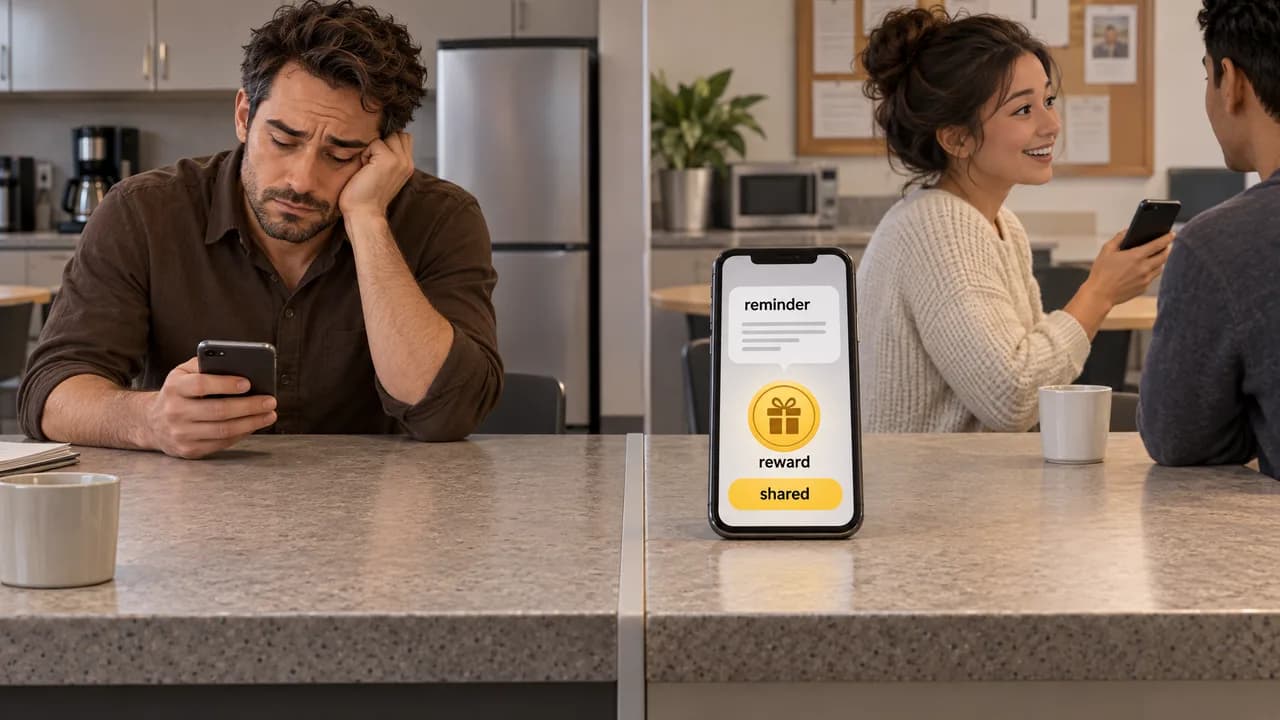
Employee incentives turn social sharing from a favor into a routine. Here is how to pick the right type, run it, and avoid the traps that stall it.

Start with structured rewards tied to specific sharing actions: points and live leaderboards for steady volume, prize contests for bursts, recognition for low budgets, and group awards for team-wide pushes. The point of an incentive program is not to buy a few extra shares this month. It is to make sharing a routine that survives the week your marketing team is buried in a launch and nobody is watching the dashboard. Most programs fail on the second part, not the first.
What Employee Incentives for Social Sharing Actually Mean
Employee incentives for social sharing are structured rewards, points, prizes, or recognition, tied to specific, measurable sharing actions an employee takes on their own accounts. The structure matters more than the reward. A $50 gift card handed out once teaches your team that sharing is a favor you ask for occasionally. A points system that credits every post teaches them that sharing is a standing part of the job, with a running score attached.
Who this serves: marketing leaders who need reach beyond a brand account's follower count, HR teams who own engagement metrics, and operations leads who end up running the program because nobody else volunteered. The last group is usually the one that quits after six weeks.
The difference from adjacent concepts is worth naming. Social media management software schedules posts from a brand account. Employee advocacy software asks employees to share those posts. Neither one, on its own, makes a person open the app on a Tuesday morning. Incentives are the mechanism that closes that gap, and it works because the reward arrives close in time to the action.
Four Kinds of Incentive Programs and What Sets Them Apart
Programs sort along two axes: what the reward is, and whether it accumulates or lands once. That split creates four workable types, plus a narrower group award that government HR guidance treats as its own category.
| Type | Reward | Structure | Best for | Main weakness |
|---|---|---|---|---|
| Points and live leaderboards | Points redeemable for prizes | Accumulates per action | Sustained weekly volume | Needs regular prize refreshes |
| Prize contests | One large prize, one winner | Fixed window, ends | Launch bursts, campaigns | Attention drops between contests |
| Recognition and informal acknowledgment | Status, shout-outs, small items | Continuous or ad hoc | Tight budgets, early pilots | Wears thin without a tangible layer |
| Group awards | Lump-sum cash or time off to a group | Tied to a performance threshold | Team-wide pushes, quarter targets | Rewards the group, not the individual |
| Individual cash bonuses | Cash per post or per month | Direct payment | Rarely the right fit | Trains people to expect pay per share |
The U.S. Office of Personnel Management's 2026 guidance on awards for federal employees defines group incentive programs as lump-sum cash payments, time-off awards, or informal recognition items given to groups who meet or exceed pre-established performance levels. That pre-established threshold is the part most private-sector programs skip, and skipping it is why so many feel arbitrary to the people in them.
What separates a program that works from one that does not comes down to four checks. First, whether the reward arrives within a day or two of the action, or weeks later. Second, whether the score is visible to everyone or filed in a spreadsheet nobody opens. Third, whether there is a tangible prize tier, not just points that never convert. Fourth, whether the program covers the whole team or quietly favors the three people who already post constantly.
The scale argument makes this worth getting right. Your employees collectively have 10x the social following of your brand accounts. A program that reaches even a third of that network outperforms most paid campaigns at a fraction of the cost, and the reason to build the structure properly is that the upside is not marginal.
How to Set Up an Incentive Program Step by Step
- Pull your last 30 days of brand-post engagement and your employee follower count, then write down the number you are trying to move. Participation rate is the honest one to start with.
- Decide which program type fits the goal. If you need steady weekly volume, pick points and live leaderboards. If you have a product launch in six weeks, run a prize contest with a fixed end date.
- Pick rewards employees will actually want, and set them in tiers so a mid-level participant still wins something. One grand prize and nothing else caps your participant count at the number of people who think they can win.
- Build the schedule before you launch. Set which days posts go out, how long each contest or cycle runs, and when results get announced. A program with no visible end date loses energy fast.
- Announce it in a place your team already reads, and put the leaderboard somewhere they will see it without hunting. If it lives three clicks deep in an intranet page, it does not exist.
- Ship the first content batch yourself so nobody has to write anything from scratch. The first ask should take ten seconds to complete, not twenty minutes.
- Post the first winner publicly, with a name and a screenshot. The announcement does more to drive the next cycle than the prize itself.
- Review participation after two weeks and adjust the reward mix. If the same three people are winning everything, add a tier for people who are new to the program.
What Happens Under the Hood When Incentives Run
Each program type moves participation through a different mechanism, and the mechanism explains the failure mode.
Points systems work by shortening the gap between the action and the payoff. Every post credits a score, the score appears on a shared board, and the board resets the comparison loop each time someone else moves ahead. What keeps it alive is that the score keeps accumulating, so a quiet week does not erase progress. What kills it is a prize catalog that never changes; once everyone has redeemed for the same two items, the points stop meaning anything.
Prize contests work by concentrating attention into a fixed window. A deadline creates urgency that a rolling program cannot, which is why contests outperform on launches. The problem is the drop-off after the winner is announced. A contest has no mechanism to carry momentum into the next week unless you seed the next cycle before the current one ends.
Recognition runs on visibility rather than value. A shout-out in a team channel costs nothing and works on the people who care about standing within the group, which is a real and durable motivator. The limit is that recognition alone cannot hold a program past the first month for people who are not already inclined to share.
Group awards change the unit of accountability. When the reward depends on a collective threshold, peers start nudging each other, which is a form of pressure no manager can replicate. The trade-off is that a few contributors can carry a group while others coast, and that builds resentment if the threshold is not paired with individual visibility.
All four share one dependency: someone has to send the reminders and publish the results on a schedule. Programs that rely on a person remembering to do this by hand die at the first busy week.
Mistakes That Drain Participation
The most common failure is making the first action too expensive. Asking employees to write original copy, find an image, get it approved, and post it produces a handful of participants and a lot of quiet resentment. Cut it to one click on pre-written content and participation triples without changing the reward.
Running a program with no visible end date is the second trap. People need to know when results land and when the next cycle starts. An open-ended points system with no prize refresh turns into background noise within a month.
Setting rewards that only the top performer can win caps your ceiling at the size of your most competitive cohort. If five people think they can win, you get five participants. Tiers fix this for almost no extra budget.
Ignoring the people who never join is the quiet one. If you never ask why someone did not participate, you will assume apathy when the real answer is that they did not know the program existed or could not find the leaderboard.
Choosing rewards that feel like unpaid work is the last one. A pizza party for a month of daily posting reads as an insult, and your team will say so in the channel where you cannot see it. Points that convert into something they choose does not have that problem.
Where Buzz 52 Fits
We built Buzz 52 for the version of this program that runs without a manager chasing people. We turn your team into a social media machine by making the sharing loop automatic: automated reminders go out on custom schedules you set, points land in live leaderboards the whole team can see, and prize contests notify winners without anyone tracking spreadsheets by hand.
The feature set maps directly onto the four program types above. If you want points and leaderboards, that is the core. If you want contest bursts, we run prize contests with winner notifications built in. If you want your brand on the front of it, you can apply custom branding and your company logo. Employees share unlimited social media posts, and you decide when the reminders land.
We are not the right pick for every team. Our scope is social media amplification for employee engagement, so if you need a full social media management suite for publishing and listening on brand accounts, that is a different category of tool. Pricing is based on team size rather than feature tiers, and the free plan covers 1 to 5 employees forever with no credit card required, so a small team can test the whole loop before committing. Teams from 6 to 49 employees move to the Standard tier with all features included, and larger organizations go to Enterprise.
Setup takes under 5 minutes. If you want to see how it would run for your own team before you decide anything, reach out to us and we will walk you through it.
Frequently Asked Questions
What is the 5-3-1 rule on social media?
It is a content-mix guideline: for every five posts of one kind, publish three of another and one of a third, most often applied to balancing promotional, educational, and personal content. Applied to employee amplification, it maps to how you sequence employee posts against brand posts in a shared feed. The ratio itself is a convention, not a measured standard, so treat it as a starting structure to adjust once you see which employee posts actually draw engagement.
What is the 5 5 5 rule on social media?
The 5-5-5 rule says to spend five minutes engaging with five accounts five times a day, a habit-building framework for growing a personal or brand presence through consistent small actions. It works the same way incentives do: frequency beats intensity. For an employee program, the lesson is that a five-minute daily sharing habit outperforms one long weekly push, which is why scheduled reminders matter more than the size of the prize.
What are the 5 C's of employee engagement?
The widely used framework lists five drivers: connection, contribution, clarity, challenge, and celebration. For an amplification program, two of those carry the most weight. Contribution is whether an employee sees that their share moved a number, and celebration is whether that contribution gets noticed publicly. A leaderboard handles both at once, which is why visible scores outperform private tracking in most programs.
What is the 50/30/20 rule for social media?
It is a content allocation guideline: roughly half your posts inform or educate, about a third engage or entertain, and the remainder promote. Employee-generated posts usually shift that mix toward the engaging end, since a personal share reads differently from a brand post. If your program produces only promotional shares, participation drops because employees do not want their own feeds to look like a company channel.
Sources
Sources checked on October 10, 2026.
Get new articles by email
New articles from Buzz 52, sent to your inbox.
By subscribing you agree to receive emails from Buzz 52 about new articles. You can unsubscribe at any time.