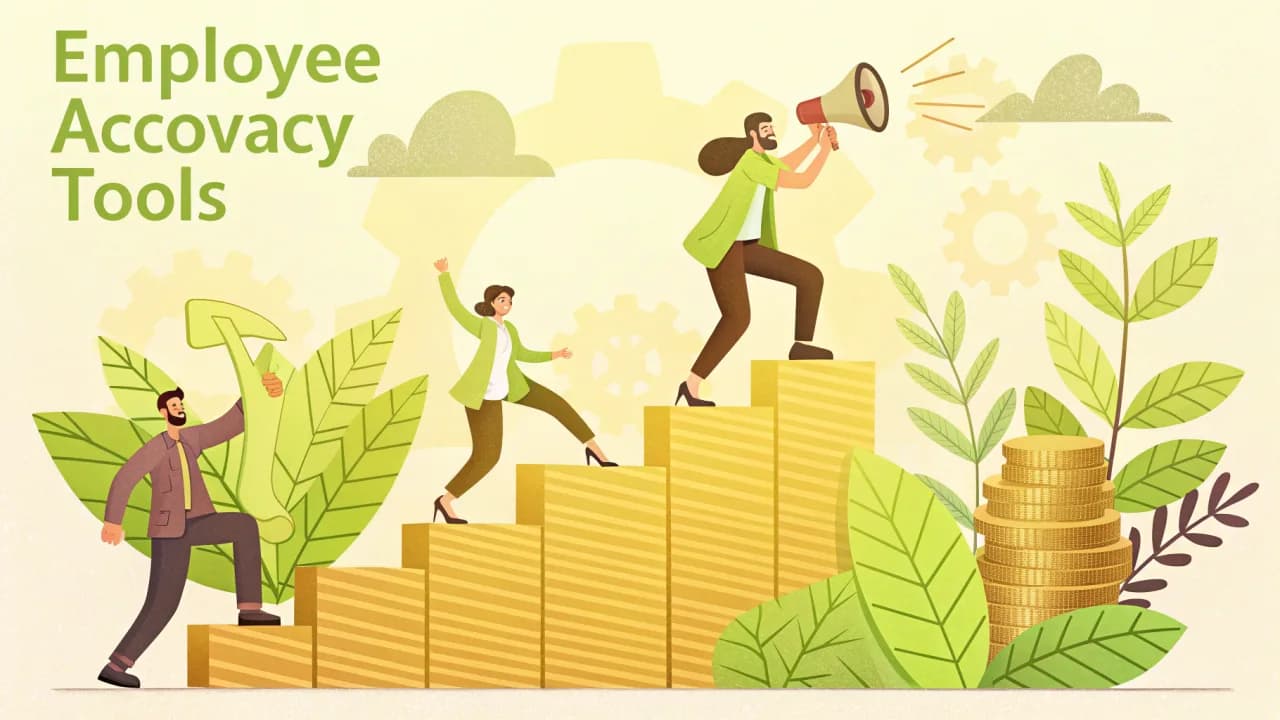
Employee Advocacy Support: Why Voluntary Sharing Programs Stall
Most advocacy programs fail in week three, not week one. Here is what actually keeps a team sharing, and the specific operational mistakes that quietly kill it.

Employee advocacy support is the operational layer that keeps employees sharing company content on their own accounts: scheduled prompts, visible standings, and rewards that make participation worth repeating. Most teams treat that as optional decoration on top of a content library. The programs that last treat it as the entire mechanism.
What Employee Advocacy Support Actually Covers
Employee advocacy is the practice of employees promoting their employer on their own social media accounts, either by resharing company content or posting their own perspective on the work, products, and culture they’re part of (Hootsuite). Support is everything that makes that practice repeatable: the content employees draw from, the prompt that tells them when to post, the tracking that shows what happened, and the incentive that makes the next post likely.
Strip the buzzwords out and it is a scheduling and motivation problem. Your team already has the reach. Your employees collectively have 10x the social following of your brand accounts (Social Champ). What they do not have is a reason to remember, on a Tuesday afternoon, that a product launch post is sitting in a folder somewhere.
That distinction matters when you evaluate vendors. A content library answers "what do we post." Advocacy support answers "why did nobody post this week," and those are different products wearing similar marketing.
It is also not the same thing as employer branding or internal communications. Both of those talk to your own people. Advocacy support asks your people to talk to everyone else, which puts a much higher bar on the ask itself.
The Signals That Separate a Working Program From a Stalled One
Employee advocacy works by turning your people, already part of the most trusted institution globally at 78%, into trusted voices for your brand.[1] That trust is the asset. The criteria below are how you check whether your program is actually deploying it or just talking about it.
- Scheduled prompts, not a shared drive. Look for whether employees get a nudge on a set cadence or have to remember to check a folder. One of these produces weekly posts; the other produces a spike after the kickoff meeting.
- Standings visible to the team. Leaderboards turn a private favor into a public, mildly competitive habit. Without them, your most active sharer gets no recognition and your quietest gets no prompt.
- Rewards tied to participation, not just to winning. Prize contests for top performers are fine, but a program where only the leader earns anything loses everyone in fourth place by month two.
- A one-click path from notification to post. Every extra step between the reminder and the published post costs you a percentage of participants.
- Engagement tracked per post, not per campaign. You need to know which prompts convert, which employees go quiet, and when.
- Setup that does not eat a quarter. If onboarding requires an IT project, the program dies before it produces data.
You can browse real program examples to see what these signals look like in practice rather than in a feature list. The pattern across all of them is the same: the prompting and the recognition carry the program, not the content calendar.
Companies with socially engaged employees are 58% more likely to attract top talent, according to LinkedIn’s advocacy research cited by Hootsuite. That number is a recruiting argument, but it is also a diagnostic. If your employees are not sharing, they are not visibly engaged, and candidates notice.
Running a Program People Actually Keep Doing
The mechanism is not complicated once you stop treating it as a communications initiative. Participation decays for three reasons: the ask is voluntary, unpaid, and invisible. An employee who shares a post gets no scheduled reminder to do it again, no visible credit for having done it, and no reward for the effort. Fix those three and the curve flattens.
This is where the build order matters, because a program that launches with a beautiful content library and no prompting infrastructure will look successful for about ten days.
- Define the cadence before you define the content. Decide how many posts per week per employee is realistic for your team, then build the content pipeline to that number. Starting from "we have twelve posts, when do people share them" produces a burst and then silence.
- Put the prompt somewhere the employee already looks. Email works. Slack works. Vista Social notes that employee advocacy content can be broadcast to specific audiences in an organization via Slack or email. What does not work is a portal the employee has to remember to open.
- Make the sharing action one click, with an option to personalize. Social Champ describes how advocacy tools give employees a shared content library, let them share pre-approved posts in one click or rewrite them in their own voice, and track engagement and reach. The one-click default is what gets the volume. The personalization option is what keeps it credible.
- Show the standings weekly. A leaderboard nobody looks at is a leaderboard that does not motivate. Put it in the same channel as the prompt.
- Attach a reward to the streak as well as the total. Rewarding the highest cumulative sharer rewards the same three people every month. Rewarding participation turns the middle of the roster into the growth engine.
- Review the participation data monthly and cut the prompts that do not convert. If a recurring post type gets shared by four people out of sixty, it is clogging the channel for the prompts that work.
The reminder cadence is doing more work than the content.
When to Build This In-House Versus Buy Help
The choice you actually face is not "software or no software." It is whether the bottleneck is the platform or the strategy, and those need different spending.
Buy platform support when the problem is repeatability. If your team would share more posts if someone reminded them, ranked them, and rewarded them, the fix is automation plus visible standings, and no amount of agency consulting will produce that on a Tuesday. In-house platform support wins whenever you need the behavior to be ongoing, because ongoing behavior is a cadence problem, not a messaging problem.
Buy outside help when the problem is one-time. A rebrand, a launch, a crisis response, or an audience segment your team has never spoken to can justify paying an agency or consultant for message development and coaching. That work has a defined end. It is a poor fit for the weekly prompt, because you would be paying for strategy every week to solve what is really a scheduling gap.
The honest test: write down what happens on day thirty if nobody sends a reminder. If your answer is "people will remember and post anyway," you do not need a platform. If it is "the program quietly stops," the thing you need to buy is the reminder. That is the decision, and most teams misdiagnose it because the content library is the visible part of the product and the prompting is the invisible part.
One edge case is worth conceding. If your organization has fewer than a handful of people who post, a shared doc and a calendar reminder can carry you for a while, and paying for a platform at that size is premature. The math flips fast once you are coordinating more than a few sharers or more than one post type per week.
Where Advocacy Programs Quietly Fall Apart
The most common failure is launching advocacy as a campaign. A campaign has a kickoff, a push, and an end. An advocacy program that ends has to be rebuilt from zero, which means every relaunch burns the novelty that made the first one work. Treat the launch as week one of an ongoing cadence, not as a quarter with a theme.
Buying software without a schedule is the close second. Teams spend on the platform, onboard everyone, and then never configure the send cadence, so the tool sits there waiting for employees to log in voluntarily. Automated reminders exist precisely to remove that dependency; if they are not set, you have bought a content library with extra steps.
Rewarding only the leader creates a quiet, permanent roster problem. The person in first place stays motivated and everyone else learns they cannot win, so they stop competing. Streak-based and participation-based rewards keep the middle of the roster in the game, which is where most of your 10x reach advantage actually sits.
Letting the C-suite go silent is more damaging than any of the above. When leadership shares nothing, employees correctly read the program as an inauthentic ask they are being graded on. Executives do not need to post the most, but they need to post visibly and first.
Finally, treating engagement numbers as the goal instead of a proxy. A post shared by sixty employees that gets no reach and no clicks is a signal that the content, not the program, needs work. Watch post-level engagement to separate "we did not prompt hard enough" from "we prompted people to share something nobody wanted."
How We Built Buzz 52 Around This Problem
We built this product because the reminder is the part everyone under-invests in. Buzz 52 gamifies employee engagement with leaderboards and rewards, and we automate the prompting layer with custom send schedules and automated reminders, so sharing happens because the system asks on time, not because someone remembers to ask.
The mechanics are deliberately simple. Live leaderboards and point tracking keep standings visible. Prize contests with winner notifications give the program a recurring reason for people to check in. Custom branding keeps the employee-facing experience recognizable as your company rather than a vendor's. You can see the full set of capabilities on our tools page.
Where Buzz 52 fits: teams that need repeatable social amplification with a setup measured in minutes, not an IT project. Our free plan covers up to 5 employees with no credit card required, and pricing scales by team size rather than by feature gating, so nothing in the product is held back at a higher tier. That last point matters because the prompting features are exactly what you would want walled off if the pricing were built around upgrades.
If your advocacy goal is tied to a broader employee recognition strategy, or if internal feedback collection is the priority, you want a different category of tool. We do one job and we do it with reminders, standings, and prizes.
Ready to stop relaunching the same program every quarter? Get your team clicking, earning, and competing in minutes. Start on the free plan or reach out on our contact page to talk through your team size and cadence.
Frequently Asked Questions
What are the three golden rules for advocacy?
Keep the prompt scheduled, the standings visible, and the reward tied to participation rather than to winning. Each rule addresses one reason participation decays. A scheduled prompt removes the dependence on memory, visible standings remove the invisibility that makes sharing feel pointless, and participation-based rewards keep the middle of your roster engaged instead of conceding the whole program to three people. Programs that follow those three rules keep producing posts in month six.
What are the four main types of advocacy?
The main forms are employee advocacy, customer advocacy, partner or dealer advocacy, and executive advocacy. They differ by who is speaking and what they have to gain. Employee advocacy is your own people sharing on their own accounts, customer advocacy is happy buyers recommending you, partner advocacy is resellers and integrators speaking on your behalf, and executive advocacy is leadership lending its reach and credibility. A team social media amplification program addresses the employee form directly.
What is employee advocacy?
Employee advocacy is the practice of employees promoting their employer on their own social media accounts, either by resharing company content or posting their own perspective on the work, products, and culture they are part of. It differs from corporate posting because the message comes from a person rather than a brand account, which is why it tends to travel further and read as more credible to the people who see it.
Sources
- Hootsuite
Employee advocacy is the practice of employees promoting their employer on their own social media accounts, either by resharing company content or posting their own perspective on the work, products, and culture they’re part of.
Checked on October 9, 2026
- Social Champ
Your employees collectively have 10x the social following of your brand accounts.
Checked on October 9, 2026
- Vista Social
Targeted communications Shareable content is automatically broadcast to specific audiences within your organization via Slack or email. Give employees a voice Employees can explore and follow topics that are relevant to their roles and even suggest content.
Checked on October 5, 2026
Sources checked between October 5, 2026 and October 9, 2026.
Get new articles by email
New articles from Buzz 52, sent to your inbox.
By subscribing you agree to receive emails from Buzz 52 about new articles. You can unsubscribe at any time.