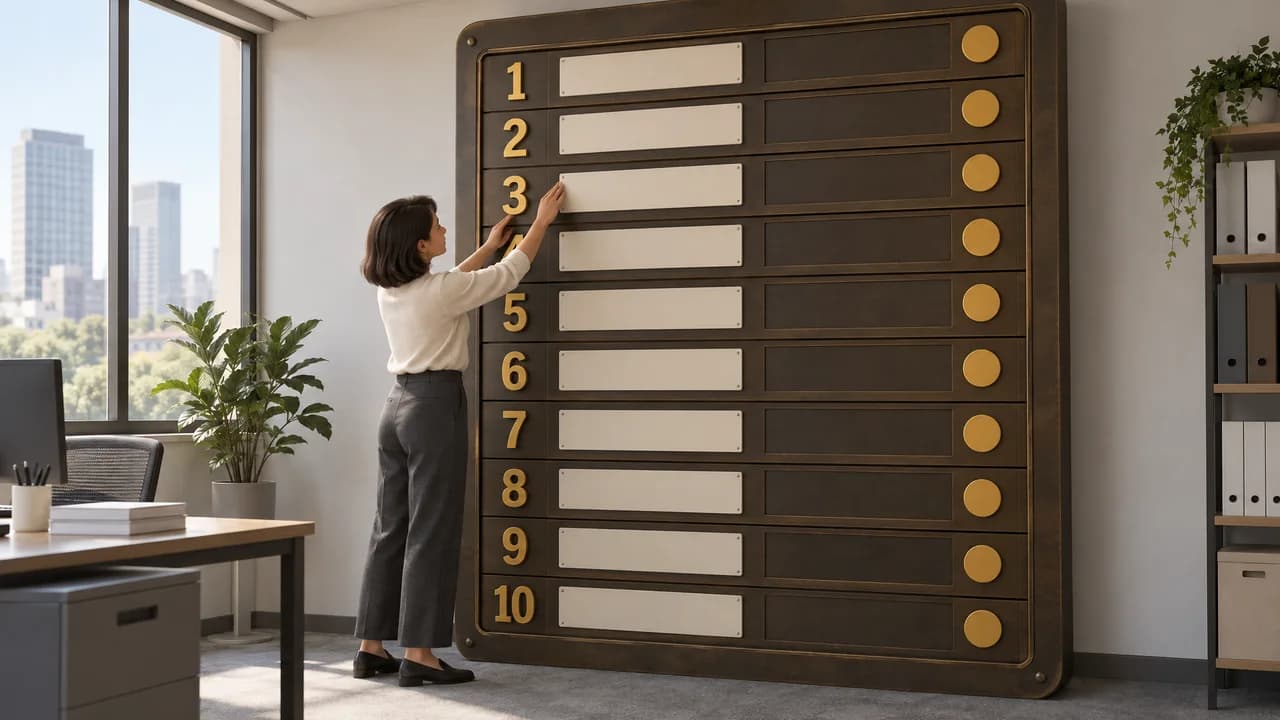
Rewards and Promotions That Keep Teams Posting Past Week One
Most employee sharing contests peak in week one because the prize is the whole design. Rewards and promotions last when a leaderboard and a fixed send schedule carry them.

Rewards and promotions in an employee sharing program are the incentives that get your team to post company content, and they only produce lasting sharing when a visible leaderboard and a predictable send schedule carry them. Change the prize and nothing changes; change the loop and the posting habit sticks. Build the recognition loop before you scale the prizes, because the prize is the smallest part of the machine.
What Rewards and Promotions Mean Inside a Sharing Program
Rewards and promotions describe the incentive layer of an employee advocacy program: the points, prizes, and recognition that move a coworker from seeing a company post to sharing it on their own feed. That definition matters because the phrase pulls double duty in search results, and half the confusion in this category comes from mixing the two meanings.
Consumer-facing promotions reward strangers for buying. Employee-facing rewards compensate your own team for distributing. The audience is the difference, and the audience changes everything downstream: a sweepstakes that pays out to anyone who enters has no relationship with whether your engineers share the product launch.
The distinction sits on a specific definition. The CIPD describes recognition as personal, non-monetary acknowledgment given to employees to reinforce effort, behavior, or achievement. That is a narrower thing than a cash bonus and a wider thing than a thank-you. It is the layer most programs skip, and the reason their contests fizzle.
Who this serves is narrower still. Programs like this live inside marketing, HR, and operations teams at companies with somewhere between a handful and a few hundred employees, where the social budget is real but the headcount to run a manual contest is not. Below five people, a shared spreadsheet still works. Past twenty, the spreadsheet is the reason nobody posts.
An adjacent concept worth separating out: recognition is not the same as compensation. A prize worth twenty dollars does not change anyone's pay, and treating it as a pay substitute is how a program turns into a sore subject. The reward's job is to mark the behavior, not to price it out.
How Recognition Mechanics Actually Drive Sharing
The pre-internet version of this work was a suggestion box with a gift card attached, and it had a real problem: the feedback loop was invisible. You dropped a slip in, you heard nothing, and you learned within a month that participating was pointless.
Modern programs fixed the loop by borrowing from game design. A 2025 Frontiers in Psychology paper describes gamification as point systems, levels, leaderboards, challenges, and rewards introduced into non-game contexts to move people toward specific goals. The important words are the last three, not the first two. Points alone are bookkeeping. The leaderboard is what makes the points visible to other people.
Three moving parts do the actual work:
- The point engine records an action the moment it happens, so sharing a LinkedIn post is scored before the sharer closes the tab.
- The leaderboard publishes standing, which converts a private score into public position.
- The send schedule delivers the post, the reminder, and the score update on a fixed rhythm, so participation never depends on someone remembering to log in.
Recognition does not have to mean money to land. LinkedIn's guidance on effective reward systems makes the case that recognition should mark progress rather than only final performance. That single change alters who can win. A monthly prize awarded to the overall top sharer concentrates the reward on the same eight people who already post without prompting. A program that celebrates the first post, the first comment, and the longest streak spreads the recognition to the edge of the team.
Recognition also only holds if it points somewhere. NAA's recognition guidance frames the value as direction: recognition strategy channels specific behaviors that advance organizational goals. Random prizes for random posts teach your team nothing about what the company's social voice is trying to accomplish.
Building the Loop: From First Post to Repeat Winner
The sequence matters more than the sophistication of any single step. Here is the order that gets a stable loop running inside a week, and the order matters because each step feeds the next one's inputs.
- Define the single behavior you are scoring. Pick one thing, usually sharing a company post to a personal feed, and score that one thing. Multiple scoring paths split the leaderboard and dilute the signal.
- Choose a send cadence you can sustain for twelve weeks, not a burst schedule for launch week. Two to five posts a week is a pace most teams can hold without someone burning out on drafting captions.
- Set the point values before anyone posts. A share, a click-through, and a comment each earn a fixed number so the standing is unambiguous from day one.
- Announce the leaderboard before the first contest opens. Publishing a scoreboard after the fact reads as a retroactive ranking; publishing it first reads as a game.
- Run the first contest for two to four weeks. Short enough that a slow start still leaves time to catch up, long enough to produce a meaningful standing.
- Award the winner publicly and restart the points. The reset is what turns a single contest into a repeating program rather than a one-off event.
- Add rewards only after participants are engaged. Prizes expand a loop that already runs; they do not start one.
If you are drafting the caption copy and the posting plan yourself, the free tools for social media managers handle the planning side. The point is to spend your scarce attention on the loop design, not on rewriting the same caption four different ways.
Where Contest Design Goes Wrong
The prize is not the problem in most failed programs. The design around it is.
Anchoring a contest on a single large prize creates a two-week event that peaks early and dies. The moment a few people pull ahead in the standings, everyone else does the math and stops posting. A structure with recurring milestones, first-share recognition, and streak points keeps more of the team in range of something worth earning.
Quiet leaderboards kill participation faster than bad prizes do. If only the administrator can see the standings, the social comparison that drives posting never happens, and a share stops feeling like a competitive act. Visibility is the mechanic, not a nice-to-have.
Spacing is another quiet killer. Contests that run once a quarter leave long stretches where nothing is scored, and habits do not survive a ten-week gap. The fix is a permanent leaderboard with short contests layered on top, so there is never a dead period in the standings.
Rewarding volume alone teaches your team to spam. If the only scored action is the number of shares, you get a burst of low-effort reposts and a feed nobody engages with. Weight a click-through or a comment so quality has a path to points too.
Holding prizes back until a grand finale is a related mistake. Winners wait weeks for acknowledgment, and the example programs worth copying announce results within days, not at the end of a quarter.
Choosing Between a Contest, a Program, or Nothing
Ask yourself two questions. Do you have more than five people who could post about the company? Do you have a social channel that benefits from their reach? Two yeses means you are choosing between formats, not between running something and running nothing.
A one-time contest fits a specific moment: a product launch, a conference, a hiring push. It is a spike, and if your goal is a spike, a two-week event with a single prize is the right tool. The trade-off is that it resets to zero the moment it ends, and you will run the same setup work again next quarter.
A standing program fits an ongoing content calendar. It costs more design effort up front, mostly in the send schedule and the scoring rules, and it produces the compounding effect that a contest cannot: people who post in week one are still posting in week twelve because the standings keep moving. If you cannot name who owns the leaderboard, the program format will decay into a contest by accident.
Size usually settles it. A team of four can run a contest on a group chat. A team of forty cannot, because the coordination overhead lands entirely on one person. The signal in this topic is simple: if you are already scheduling the posts, tracking who shared what, and chasing results by hand, you have outgrown the manual format and the question is no longer whether to use a platform.
Say no if your team does not post publicly about work, or if company policy keeps employee social activity off-limits. In that case a program has nothing to amplify. The contact page is where to ask whether your setup fits before you build anything.
How We Fit Into Your Sharing Program
We gamify employee engagement with leaderboards and rewards, and we keep setup under five minutes. Automated reminders, custom send schedules, live leaderboards with point tracking, prize contests with winner notifications, and custom branding cover the loop. Unlimited social media posts and rewards and prizes round out the feature set.
Our pricing is based on team size, not feature limitations, and we scale from a free tier for one to five employees through Standard for 6 to 49 employees to Enterprise for 50 or more. Every plan carries the full feature set, so a small team is not buying a stripped-down version of the product.
If your goal is not employee social amplification, our platform is not built for that, and we would rather you know it now. If your team falls under five people, a group chat and a shared doc may be all you need.
Start on the free tier, run one contest, and watch the leaderboard before you commit to anything paid. When you are ready to talk through a program for a larger team, talk to our team.
Frequently Asked Questions
How do I check my rewards?
Standings live on the leaderboard, which tracks points as they are earned, so checking your rewards is a matter of opening the board rather than waiting for an email. Contest-specific results appear when the contest closes, and automated reminders keep the current standing in front of you between contests. If you are running the program, the points reset at the start of each contest cycle, so confirm which cycle you are looking at before you read your position.
How do I receive my rewards?
Prize contests issue winner notifications, so receiving a reward starts with the notification rather than with the standings alone. Physical or digital prizes are coordinated by the program administrator who set up the contest, and winners are announced publicly to keep the recognition visible. The leaderboard establishes who won; the notification is what tells you when to expect the reward itself.
How do you redeem your rewards?
Redemption depends on what the program put up as the prize, since prize contests cover anything from gift cards to branded merchandise. The administrator handles fulfillment for the contest they created, and the winner notification is where the specifics appear. Points themselves are a running score, not a currency you spend, so redeeming means claiming a prize you won rather than cashing in a point balance.
What is the difference between rewards and promotions in this context?
Rewards go to your employees for sharing company content; promotions in the consumer sense go to customers for buying. The overlap is the mechanic, not the audience. Score the behavior you want repeated, and make the score visible to the people whose behavior you are trying to change.
Do I need a platform, or can I run this with a spreadsheet?
Under five employees, a spreadsheet works. Past that, the manual version fails on the same thing every time: nobody wants to be the person chasing shares and tallying points. A platform handles the reminders, the scoring, and the winner notifications so the program survives past launch week.
Get new articles by email
New articles from Buzz 52, sent to your inbox.
By subscribing you agree to receive emails from Buzz 52 about new articles. You can unsubscribe at any time.