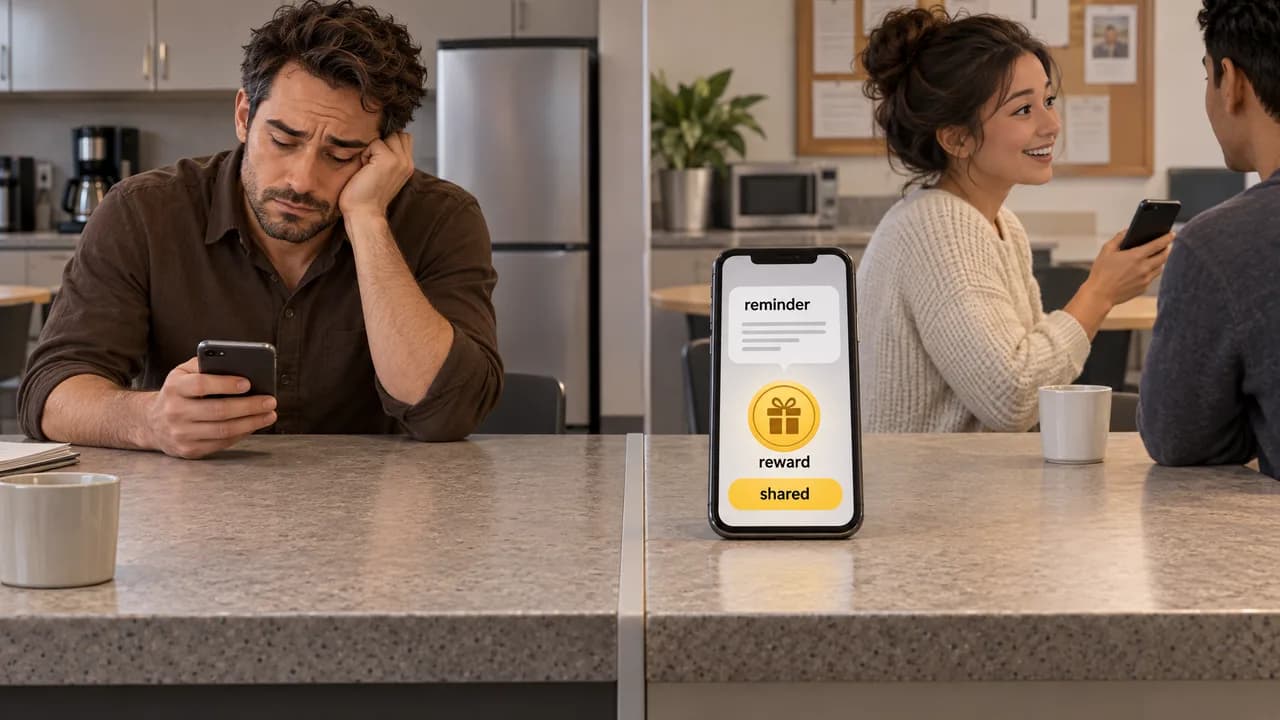
Social Sharing Gamification for Remote Teams: What Works
Remote teams do not fail at social sharing from lack of enthusiasm. They fail because nothing in the workday closes the loop between seeing a post and sharing it. Here is the structure that does.
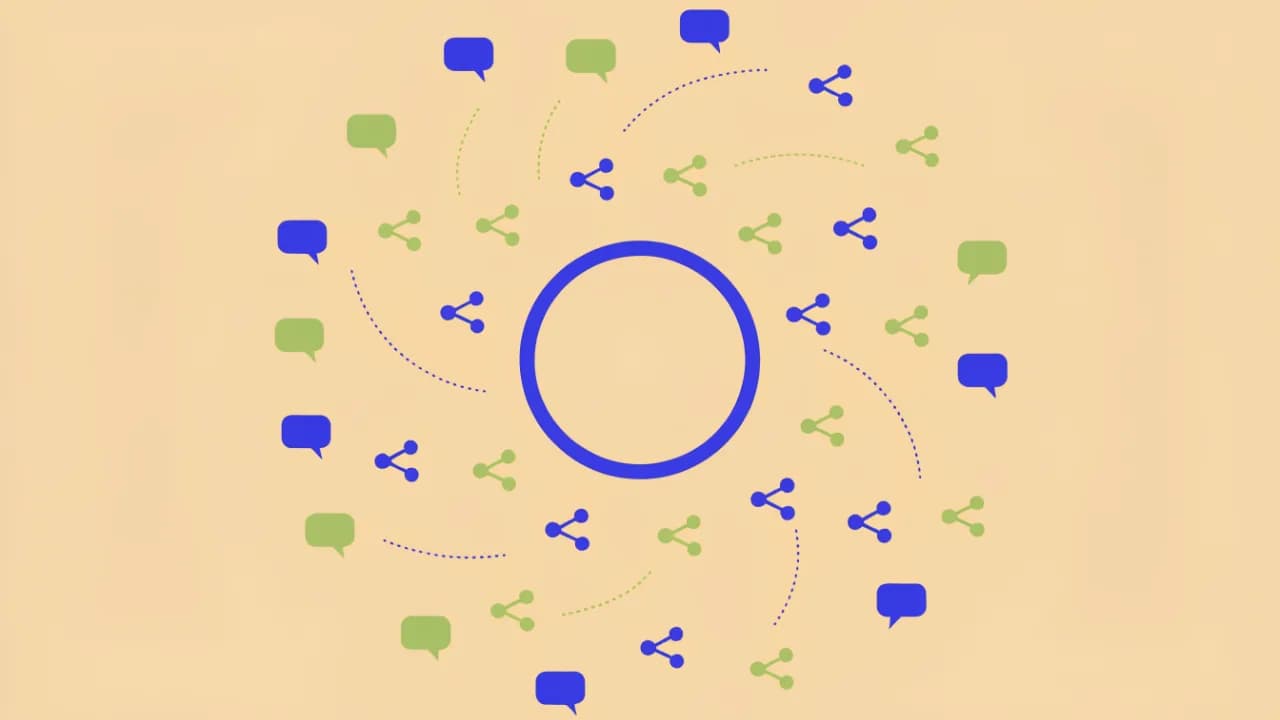
Social sharing gamification for remote teams means turning employee advocacy into a repeating loop of scheduled prompts, visible progress, and earned rewards instead of a one-time request to post. Most programs die because they are built as an event: a launch announcement, a burst of posting, then silence by week two. The structure that survives is closer to a standing meeting than a campaign, and the difference is entirely in whether the loop closes every day.
What Social Sharing Gamification Actually Means
Social sharing gamification is the practice of attaching points, rankings, and prizes to the act of employees sharing company content on their own social accounts, and running it as an ongoing program rather than a campaign. It serves teams whose marketing reach depends on people rather than budget, which in practice means distributed and remote organizations where nobody walks past a poster in the break room.
The distinction from ordinary employee advocacy matters. Advocacy says "please share this." Gamification answers a different question: what happens in the next ten minutes after the post goes live? A remote employee has to notice the request, decide it is worth their personal feed, find the link, and write something. Four decision points, four chances to stall.
It also differs from generic recognition software. Recognition platforms celebrate work people already did. This creates work that would not otherwise happen, on a schedule, with a measurable output. That is a marketing function wearing an engagement costume, and teams that forget it end up with a leaderboard nobody connects to a business result.
The reach math is the reason it is worth the trouble. Your employees collectively have 10x the social following of your brand accounts, according to Social Champ. A remote team is a distributed media network that already exists and is currently switched off. If you already run the reporting side of this, the free tools for social media managers cover the audits and benchmarks that come before a program launch.
How the Habit Loop Works Under the Hood
Underneath every working program is one cycle repeated until it becomes automatic. A prompt arrives. The share takes one action. Points appear somewhere the team can see. A reward eventually lands. Cut any of those four links and participation decays.
The prompt is the part remote teams most often skip. In an office, a Slack message, a screen, or a colleague's comment does the reminding. Distributed, the reminder has to be pushed, and it has to arrive at a predictable time. Email broadcast to a specific audience is one delivery route; Vista Social notes that employee advocacy content can be broadcast to specific audiences via Slack or email. A custom send schedule matters more than it sounds: a prompt that lands at 6 p.m. on a Friday is a prompt that gets ignored.
The share itself has to cost nothing mentally. If an employee has to open an app, find the post, copy a caption, and paste it into three networks, most will not. One tap that posts or copies ready-made text is the difference between a program and a wish.
Visible progress is what converts a chore into a game, and it is the piece remote teams underestimate. On a distributed team, nobody sees anyone else posting. A leaderboard recreates the accidental social proof an office provided for free. Points that update live turn a private decision into a public one, and public decisions get made faster.
Rewards close the loop, but they work on a longer clock than points. Points need to move daily. Prizes can run weekly or monthly. The mistake is expecting the prize alone to carry the daily habit: a contest that pays out in three weeks does nothing for Tuesday afternoon.
There is a real business case beyond reach. Remote candidates weigh visible culture heavily because they cannot visit and judge it in person. A team whose people post about their work is advertising the workplace to the exact audience you recruit from.
Standing Up a Program in Five Moves
- Pick one recurring slot per week for the whole team, then decide the cadence per person. Two to three prompts weekly is enough to build a habit without becoming background noise.
- Load a month of shareable content before the first prompt goes out. Link posts, short remarks, team milestones, and anything with a photo. Nothing kills momentum like a prompt with nothing behind it.
- Write the caption for them. Pre-filled text with a slot for personal commentary gets shared far more than a bare link, because it removes the blank-page problem.
- Publish the scoreboard from day one and leave it up. Not a weekly email. A live board with names and points that anyone can check at any moment.
- Attach a small, fast reward. Weekly winner, small prize, publicly announced. Then a larger monthly one. Fast and frequent beats big and rare when you are building a habit.
What to Check Before You Commit
The criteria that actually separate programs that work from programs that stall:
- Prompt scheduling. Look for custom send schedules and automated reminders. If you cannot set the day and time, the loop depends on a human remembering.
- The sharing action. Count the steps from opening the prompt to the post going live. Anything past two steps will lose your team.
- Leaderboard visibility. Live point tracking the whole team can see, not a report the admin reads. Visibility is the mechanic, not a nice extra.
- Reward mechanics. Prizes, recurring contests, and winner notifications. Ask how many times a year you can run a new contest and how the winner finds out.
- Volume limits. Whether the plan caps how many posts the team can share or how often you can prompt.
- Setup time. How long until the team is actually using it. A tool that needs a project to configure will not survive a busy quarter.
- Brand control. Whether posts carry your logo and whether you can see what went out.
Where Remote Programs Fall Apart
Running the whole thing as a single contest is the most common failure, and it is an easy one to fall into because contests produce an exciting first week. Points spike, engagement looks real, then the contest ends and posting goes back to zero. The fix is recurring prize contests on a schedule, so the reward is always the next one, not the last one. A launch event may belong at the start, but it cannot be the program.
Leaving the leaderboard private kills a program quietly. Admins check the numbers, feel good, and see no behavior change because the team never sees anything. Points only motivate when they are visible, so the leaderboard has to be part of the daily surface, not a monthly summary.
Prompting the same small group is another trap. Remote teams develop cliques, and a program that only activates the four people who already post will look successful in the metrics while half the team is invisible. Rotation and open participation matter, and so does making a low score feel like a low score without shame: a shared board where everyone appears does that better than public rankings of only the top ten.
Skipping the content backlog is the fourth, and it produces the least interesting failure. The program works for three weeks, the team runs out of material, and someone starts sharing generic industry articles that nobody wants to attach their name to. The engine needs a supply of content before it needs a prize.
Finally, treating participation as a loyalty test. Remote employees know when a program exists to harvest their personal network for free. The teams that sustain it treat points and prizes as the honest trade, and they never ask for a post they would not share themselves.
Deciding Whether Your Team Is Ready
You are deciding between two options, and they are not equally good. You can run social sharing on a gamified, pushed cadence with a dedicated system. Or you can keep asking in a team channel and hope.
The signals that settle it are concrete. Are at least five people on the team willing to post from a personal account? Does a meaningful share of them have a profile on the platform where your buyers are? Is there real content to share at least twice a month? If all three are yes, the pushed structure wins on every measure that matters, and the failure mode is losing a few hours a launch day.
If the answers are mostly no, a structured program is the wrong purchase. Two people sharing sporadically do not need gamification; they need a well-written post and a note. Nothing about a leaderboard improves a program where the underlying network does not exist.
There is a middle case worth naming: teams of six to twenty across several time zones. These are the groups where remote structure hurts most, because the accidental prompting an office provides is completely absent. More distributed teams produce more coordination, not more platforms. The system you pick should reduce the number of places people have to look, not add one.
About Buzz 52
We built Buzz 52 around the loop described above. The product gamifies employee engagement with leaderboards and rewards, a simple, scalable pricing model, and a focus on social media amplification. Team size sets the plan, not the feature set.
That means automated reminders, leaderboards, rewards and prizes, unlimited social media posts, custom send schedules, live leaderboards and point tracking, prize contests with winner notifications, and custom branding with your company logo. Setup runs under five minutes and includes our logo and your team's, so the surface looks like your company rather than a vendor's.
Who should choose something else: if your team is smaller than five people, or your business has no active social presence worth amplifying, you do not need this yet. Our limit is real. We build for social amplification, not for broader employee recognition or performance management. Free covers teams of up to five employees forever, Standard covers six to forty-nine with everything included, and Enterprise is priced per employee per month for fifty and up. Current numbers live on the pricing page, because we would rather you see them there than trust a figure from any article.
Ready to see it running against your own team's posts? Talk to us about your program and we will set you up.
Frequently Asked Questions
What are some fun games to play with remote teams?
Anything with a visible scoreboard and a fast turnaround works. Prediction games on real work outcomes, trivia tied to company knowledge, and caption contests on a shared photo all fit. The structure that holds up is the same one that keeps sharing alive: a prompt, an open scoreboard, a small prize, and a new round starting immediately after the last one ends. The schedule recurs, so participation never depends on someone remembering to schedule it.
What are some good 10-minute virtual team building activities?
Ask each person to share one recent win publicly and give the rest of the group thirty seconds to react in the channel. Run a two-question poll where the results are visible to everyone. Give each teammate one turn as the person who posts the company update that week. These are short, they create the daily habit of posting publicly, and they produce content your marketing team can actually reuse later.
What are some fun activities for remote employee engagement?
Points-based activities outperform one-off socials because the stakes stay live. A weekly caption contest where the winner posts to the company account, a share streak that shows who has participated every week, and a recurring prize draw for anyone who hit a threshold. The common thread is a scoreboard everyone can see and a reward close enough in time to feel connected to the action.
How to collaborate effectively if your team is remote?
Set a default channel for daily work, publish every decision where the whole team can see it, and write down ownership instead of assuming it. Remote teams break on unwritten expectations, not on tools. The same holds inside a sharing program: one schedule everyone knows, one place the leaderboard lives, and a shared content backlog that anyone can add to when they find something good.
Sources
- Social Champ
Your employees collectively have 10x the social following of your brand accounts.
Checked on October 9, 2026
- Vista Social
Targeted communications Shareable content is automatically broadcast to specific audiences within your organization via Slack or email. Give employees a voice Employees can explore and follow topics that are relevant to their roles and even suggest content.
Checked on October 5, 2026
Sources checked between October 5, 2026 and October 9, 2026.
Get new articles by email
New articles from Buzz 52, sent to your inbox.
By subscribing you agree to receive emails from Buzz 52 about new articles. You can unsubscribe at any time.