What Buzz 60 Gets Wrong About Employee Social Sharing
Employee advocacy only compounds when participation is engineered to continue.
The people searching "buzz 60" and "buzz 50" are usually looking for a burst of reach, and that instinct is exactly what makes most employee sharing programs fail. A campaign spikes, the team feels good for a week, and then the graph slides back to zero because nothing keeps anyone participating when the novelty wears off.
We sell employee engagement software, so read the next part knowing where we sit. But the pattern is real regardless of vendor: the programs that produce compounding reach are not the ones with the best content. They are the ones where a reminder, a visible score, and a reward keep showing up after the initial enthusiasm dies.
That is the argument this piece makes. Reach from employee sharing is a habit problem, not a content problem, and habits need machinery.
Quick Answer
Sustained employee social sharing programs outperform one-off posting bursts because automated reminders, visible leaderboards, and reward cycles convert a short-lived spike into a repeating habit that keeps producing reach month after month. The short version: bursts decay, habits compound. If your team shares for two weeks and then stops, you have paid the coordination cost of a program without collecting the compounding benefit.
We are an employee engagement SaaS platform built to turn your team into a social media machine, with automated reminders, leaderboards, and rewards doing the coordination work a manager cannot sustain by hand. Setup takes under 5 minutes, and the free tier covers teams of one to five employees with no credit card required.
What Buzz 60 Actually Refers To
A "buzz 60" style query almost always describes a burst: sixty seconds, sixty posts, a sixty-day push, some short interval of intense activity that a team can rally around. The number is not the point. The shape is. People search for it because a bounded, finite burst is easier to sell internally than an open-ended commitment.
That is understandable and largely wrong for social reach.
The adjacent cluster of searches, buzz monitoring tools and similar, reveals a second assumption worth naming. Teams often believe the bottleneck is knowing what people are saying. Monitoring has its place, and we wrote about where it actually pays off in buzz monitoring tools only pay off when the team shares. But knowing what is being said does nothing for reach if nobody on your team is posting. Listening without distribution is a spectator sport.
Employee sharing programs sit in a different category entirely from monitoring. One tells you what the market thinks. The other changes what the market sees. Confusing the two is where a lot of budgets go to die.
How Gamified Sharing Programs Actually Work
The mechanism is simpler than the marketing around it suggests. Every effective program runs three loops, and each one fails independently.
The first loop is the trigger. Something has to prompt the person to open the app and share, because nobody remembers to do it on their own. Automated reminders on a custom send schedule replace the manager who used to send the "hey, don't forget to share this" message three times a week and eventually gave up.
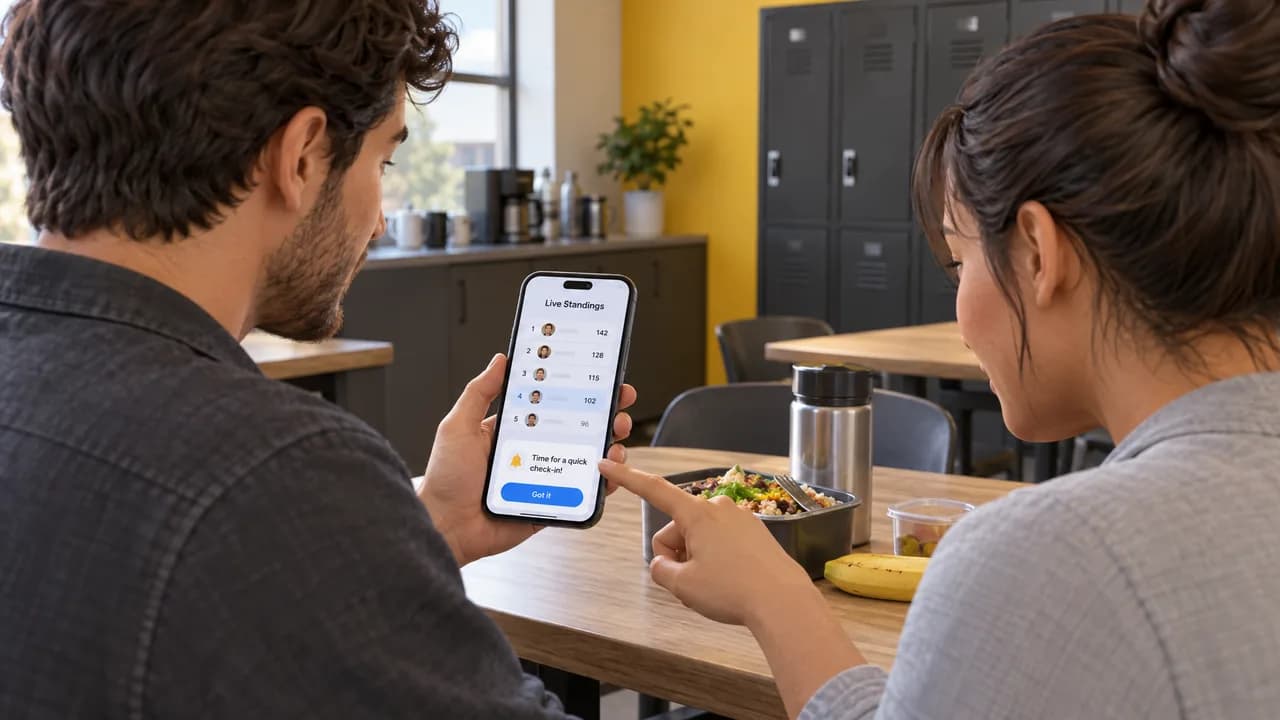
The second loop is the score. A leaderboard makes participation visible and comparable, which is a different psychological lever than a request. Points accumulate, standings shift, and suddenly sharing has a consequence beyond mild guilt. This is the part most programs skip, and skipping it is why so many advocacy initiatives quietly die in month two. We go deeper on that mechanic in why advocacy tools need gamification to succeed.
The third loop is the payoff. Rewards and prizes close the circuit. A prize contest with an automated winner notification does something a manual draw never does: it proves, on a schedule, that participating was worth the thirty seconds.
Break any one loop and the whole thing stalls. Reminders with no score feel like nagging. A score with no reward feels like surveillance. Rewards with no reminder never get claimed.
Where the historical shape comes from
Employee advocacy as a discipline grew out of the same thinking that produced word-of-mouth marketing, which the 2007 book chapter on live buzz marketing in Connected Marketing describes as an active, orchestrated practice rather than something that simply happens. That framing matters. The early assumption was that buzz is generated; the modern understanding is that it is maintained. The shift from campaign to cadence is the entire story of why programs that feel like a sprint underperform programs that feel like a season.
The Step-by-Step Approach to Launching a Program
The sequence matters because each step produces the input the next one needs. Skip ahead and you will run a program with no participants or participants with nothing to do.
- Pick the channel set and the cadence before you invite anyone. Decide which social platforms matter, how often you want posts going out, and who owns the schedule. This is the input everything else depends on, because reminders are only as good as the cadence behind them.
- Write the first month of shareable content into a queue. Twenty to thirty items is enough to start. The goal is that no participant ever opens the app and finds nothing worth posting, because an empty queue on day three teaches people the program is dead.
- Set up automated reminders on a schedule your team can tolerate. Twice a week is a workable starting point for most teams. Daily reminders read as pressure and get muted.
- Turn on the leaderboard and decide how points work. Simplicity wins here. Points for a share, points for an engagement the post earns, points for a referral. If the scoring needs a paragraph to explain, it is too complicated.
- Attach prizes with a visible deadline. A monthly contest with a real prize and an automated winner notification gives the program a rhythm. Participants need to see the clock.
- Send the first invite and watch the signup rate, not the share rate. Signups tell you whether the ask landed. Shares follow once the first leaderboard reset happens and people see standings move.
- Review at day thirty and cut whatever nobody used. The features your team ignores are the ones to remove, because a cluttered program is a program people stop opening.
If you want to talk through how this maps to a specific team size, our contact page is the place to start.
Mistakes That Kill Advocacy Programs
The most damaging mistake is treating the program as a campaign with an end date. A sixty-day push teaches your team that sharing is a temporary obligation, and the moment it ends, participation goes to zero.
Slightly less obvious is the launch-and-abandon pattern. Programs rarely fail because people refuse to participate; they fail because the person who launched it changed roles, and nobody inherited the job of refreshing content and resetting contests. This is why automation matters more than it sounds like it should. A program that runs on a single champion's attention has a single point of failure, and that person will eventually get busy.
Then there is the leaderboard nobody can see. Burying the ranking three clicks deep in an app people open twice a week is functionally the same as not having one. Visibility is the feature. A score that only appears when someone remembers to look does not create the competitive pull that makes gamified programs work.
Content that nobody wants to put their name on deserves its own paragraph. Employees are being asked to attach their personal reputation to your message. If the copy reads like a press release, they will quietly decline, and no amount of points will fix a genuine reputational risk in their eyes.
And the last one: rewarding only the top performer. If the same three people win every month, everyone else learns that the contest is not for them and stops competing. Contests that reward participation broadly, not just excellence narrowly, keep the middle of the pack in the game. For more on keeping this humane rather than pushy, see encouraging employees to share without nagging.
When to Act and When to Wait
Your team size is the clearest signal. Under five people, you can probably coordinate sharing well enough with a group chat and a shared folder, and the coordination tax is low because everyone already talks daily. Past that threshold, the manual approach starts to leak. Somebody forgets to send the reminder, the content queue goes stale, and the program fades without anyone deciding to end it.
The second signal is whether you have a distribution problem or a content problem. If your posts are good and your reach is thin, you have a distribution problem, and a sharing program addresses it directly. If your content is genuinely weak, adding forty more people to the amplification chain just spreads weak content faster. Fix the message first.
The third signal is appetite. If your team already asks to share company news, you have permission to build a program. If every mention of social media produces visible reluctance, start with a small pilot group of five or six volunteers before rolling anything out company-wide. A program that launches to indifference is much harder to resurrect than one that launches to a waiting audience.
How We Approach This
We built Buzz 52 around the three loops described above, because we kept watching the same failure: teams launch with energy and lose the machinery that keeps it running. Automated reminders handle the trigger. Live leaderboards and point tracking handle the score. Rewards, prize contests, and automated winner notifications handle the payoff.
Pricing scales with team size rather than feature gates: free for one to five employees, Standard for six to forty-nine, and Enterprise for teams of fifty or more. You can check the current numbers on our pricing page rather than trusting a figure quoted in an article that will age badly.
Two things we are honest about. Our focus is social media amplification for employee engagement, so if you need a broad recognition platform with surveys and feedback tools, that is a different category of product and we are not it. And we do not publish specifics on data security and compliance because pricing and feature details change faster than documentation, so ask us directly before you commit.
Custom branding puts your company logo on the experience, which matters more than it sounds when the program has to survive a rebrand. Unlimited posts mean you are never rationing participation. And because the whole thing runs on a schedule rather than on somebody's memory, it keeps going when the person who set it up moves on.
Get new articles by email
New articles from Buzz 52, sent to your inbox.
By subscribing you agree to receive emails from Buzz 52 about new articles. You can unsubscribe at any time.