Employee Social Sharing Schedule Automation: A Working Guide
Employee social sharing schedule automation is a fixed, recurring cadence that pushes branded posts to your team with reminders, points, and prizes attached. The schedule matters more than the platform.

Employee social sharing schedule automation is a recurring, rules-based cadence that puts branded posts in front of your team with reminders, points, and prizes attached, instead of an ad-hoc email asking people to share when they get a chance. The schedule itself does the work; the platform is just the delivery mechanism. Most programs that fail were never short on willing employees, they were short on a fixed rhythm that survived a busy Tuesday.
What This Term Actually Means
Employee social sharing schedule automation is the practice of moving employee advocacy from a request into a calendar. It describes a system that decides, in advance, which branded posts go to which employees on which days, then delivers them with a reminder attached and a score attached to the share.
That definition separates it from three things people confuse it with. Employee advocacy is the broad strategy of getting your workforce to talk about the company publicly. Content distribution is the broad strategy of getting your posts seen. A social media management tool is software that publishes to your brand's own channels. Schedule automation sits between advocacy and distribution: it does not decide what your brand posts, and it does not replace your advocacy strategy. It fixes the pacing.
The audience for this is narrow and specific. Marketing leaders who own a reach number, HR teams who own participation, and operations people who end up administering perks nobody asked them to administer. If you have a handful of employees who share sometimes and a larger group who never do, the gap is usually a scheduling gap, not an enthusiasm gap. When you map the week before you write a single post, the program looks less like begging and more like an operating rhythm you can hand to someone else.
How It Actually Works
The moving parts are few, which is why the discipline is hard to fake. There is a queue of approved branded posts, a set of schedule slots, a delivery channel, a scoring rule, and a visible leaderboard. Each part does one job.
The queue holds the content. Posts enter it from your marketing calendar rather than from a last-minute Slack message on a Friday. A queue with a two-week horizon is enough to absorb a sick day, a product launch, and a holiday week without anyone scrambling.
Schedule slots decide cadence. Pick two or three fixed windows a week and hold them.
Delivery is where most setups leak. A reminder that arrives in a channel the employee already ignores is a reminder that never arrived. Push to whatever surface your team checks on a shift: a work chat, a pinned post, a mobile notification.
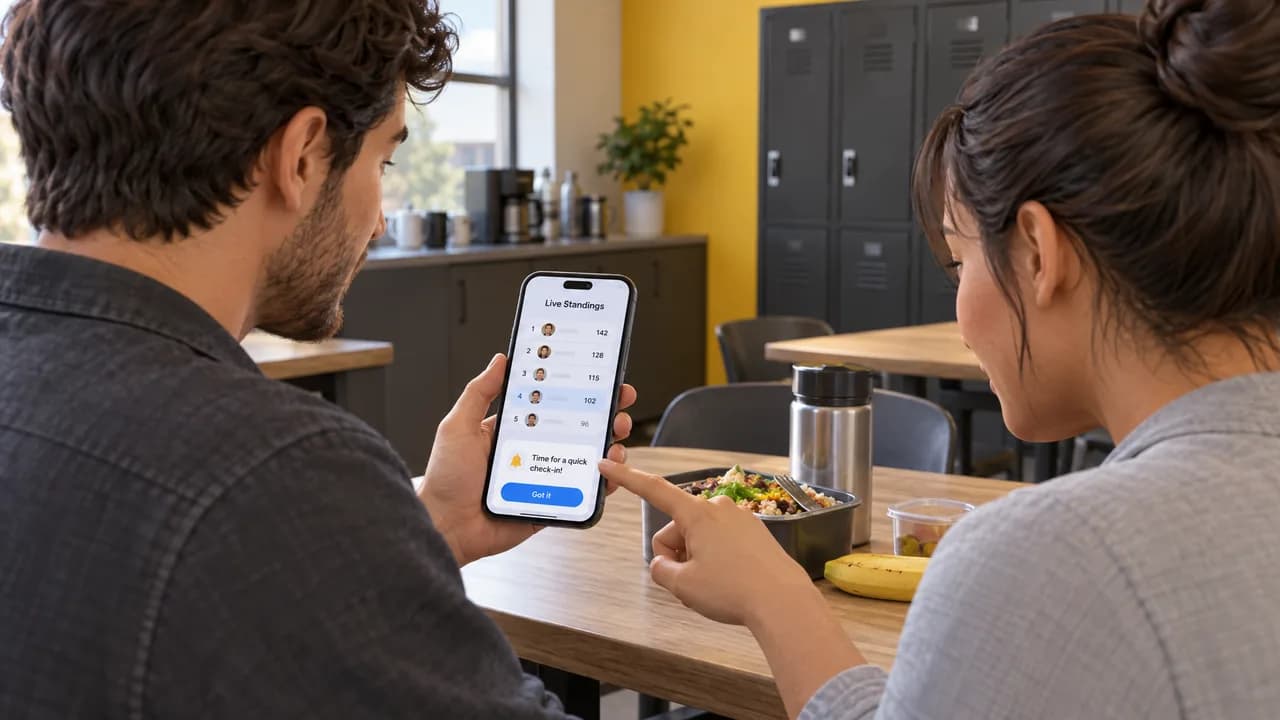
Scoring and the leaderboard are the part people underestimate. A calendar slot without a visible scoreboard is just a reminder. Points have to move in public and in near real time for the contest to feel like a contest rather than a compliance chore.
Retire the pre-scheduled-content-approval pattern, where a social team drafts a month of posts and asks employees to copy them manually. That model assumed the bottleneck was content supply. The bottleneck is attention, and attention responds to cadence and visible progress far more than it responds to a shared drive folder.
How to Do It
The sequence below runs in order. Each step feeds the next, and skipping one usually shows up two weeks later as a participation cliff you cannot explain.
Write down the number you are trying to move. Reach, clicks, applications, event signups, whatever your marketing lead already reports. A program without a target number cannot be defended at budget review.
Pick two or three fixed weekly windows and put them in a shared calendar that other people can see. Consistency matters more than the specific hour, so pick times your team is already at a screen.
Load a two-week content queue from posts your brand already publishes. Recycling existing branded content removes the excuse that nobody had anything to share.
Set the delivery surface to wherever your team actually looks, and turn reminders on. One reminder is a nudge, three is a nuisance, so pick the cadence once and leave it.
Attach a scoring rule to the action you want. A share is one point, a share with a personal line is two, a signup attributed to a share is five. Keep the rule short enough to explain in one sentence.
Run the first contest for a fixed period, then close it and name winners publicly. Contest length matters less than the fact that it ends and the winner is real.
Publish the cadence and stop adjusting it. Consistency and clean scorekeeping are the two things that keep a program alive past the first month.
Because the sequence is short and does not require a dedicated headcount, it fits teams far smaller than most advocacy vendors assume. Automated employee social media for small business is not a watered-down version of enterprise advocacy; it is the same loop with fewer people in it and a stricter calendar.
Where People Go Wrong
Programs die from the same handful of causes, and the causes are almost never technical.
The schedule drifts. Week one runs Tuesday and Thursday, week two runs whenever someone remembers, and by week four the team has learned that the cadence is optional. The fix is unglamorous: hold the slot even when the content queue is thin. Send a shorter post rather than skipping the window.
Points get complicated. Someone adds a bonus for shares that get likes, then a penalty for duplicate shares, then an exception for the sales team, and now nobody can predict their own score. When employees cannot predict their score, they stop trying to earn it. Keep the rule to one sentence and resist the mid-contest patch.
The finish line moves. A contest with a clear end date and a named winner teaches the team how the game works. A contest that quietly rolls over into a permanently running program turns rewards into a salary expectation and removes the reason anyone feels a push near the end.
Reporting replaces the scoreboard. Wrapping up a quarter and telling employees how the program performed is useful for you and useless to them. They need to see their own points now. A number that arrives three weeks late cannot influence a decision someone makes on Thursday morning.
Rewards go stale and nobody asks. Fifty dollars of coffee credit means something to one part of your team and nothing to another, and a program with one generic prize quietly selects for the people who already wanted to share. Ask a rotating group what they would actually use, then change it.
Publish the boundaries to your team once, in writing. Say what is scored, how long contests run, when winners are announced, and what happens to a share that goes out late. Nobody argues with boundaries they can see.
When to Act
You are ready to automate the cadence when participation has already happened informally and you want it to keep happening. That shows up as a small group who shares on their own, a larger group who would share if someone asked them at the right moment, and a marketing calendar nobody is feeding from the outside.
Three signals settle the decision in favor of fixing the schedule first. Your sharing requests are ad hoc, landing whenever someone remembers to send them. Your participation numbers rise during a push and fall back within two weeks. You have content ready to go but no reliable mechanism to place it in front of people at a predictable time.
Hold off in two cases. If the system you need is a way to publish on the company's own branded channels, that is a social media management tool and it solves a different problem: publishing your brand's posts, not activating your employees. And if your team has no capacity to share anything at all in the next quarter, a program will not create that capacity; it will only document the shortfall. Fix the workload first, then return to the calendar.
If you do proceed, your first thirty days should produce three things: a published weekly cadence, a leaderboard your team can see without asking, and one completed contest with a named winner. Miss those three and you are running the pre-scheduled-content-approval pattern with extra steps.
About Buzz 52
We built Buzz 52 for the specific loop this article describes: a repeating schedule, a visible score, and a reward at the end. Turn your team into a social media machine. We automate the reminder, the leaderboard, and the prize draw so the schedule runs whether or not anyone remembers to send it. A custom send schedule lets you fix the days and times once, and the platform holds that cadence week after week. Points track live, so the leaderboard moves while the contest is running, not after it closes. Prize contests carry winner notifications, which closes the loop for the person who actually shared.
Two things shape who this fits. Pricing scales with team size rather than feature tiers, so the free plan covers up to five employees and the paid tiers open up as you grow. You can start on the free plan with no credit card required and see whether your team responds to a fixed cadence before you commit budget. Setup takes under five minutes, and posts carry your own branding.
We are also honest about the shape of the product. Buzz 52 is built for social media amplification inside an employee engagement program. If your actual problem is publishing to the company's own accounts, or building a training curriculum around social selling, a dedicated advocacy or social management platform is the better fit and we are not the right tool for it.
If a fixed cadence with a visible scoreboard is the problem you are trying to solve, talk to us and we will show you what your first two weeks would look like.
Frequently Asked Questions
How many posts per week should the automated schedule send?
Two is a sound starting point: enough to build a habit, light enough that people stop reading if they are not interested. Three works when your content queue is genuinely fresh every week. The cadence matters more than the volume, because a fixed Tuesday and Thursday slot becomes a remembered habit while a daily drip becomes background noise. If you can only sustain one slot reliably, one is better than an ambitious two you skip half the time.
Do we need a dedicated advocacy platform to run this?
Not necessarily. A small team can run a real program on a set of regular slots, a two-week content queue, and some form of visible scoring. The reason to move to a dedicated platform is that point tracking, leaderboards, recurring reminders, and prize contests are slow and error-prone to run by hand across a roster. If you have fewer than five employees and one weekly slot, manual delivery is fine. Past that, administration starts costing more time than it saves.
How do we keep participation alive after the first contest ends?
End one contest and start the next rather than letting a single reward period run indefinitely. A contest with a clear finish and a named winner teaches your team how the game works and gives them a reason to push near the end. Wrapping up a quarter and announcing a team-level result is useful to you and invisible to the employee who wants to know whether their own share counted. Keep the personal score current and close each contest on the date you published.
Which employees actually respond to a sharing program?
The ones who already share occasionally on their own, plus the ones who will share if the request arrives at a predictable moment with a reason attached. Publishing the scoring boundaries in writing raises the real floor. The people who do not respond tend to be the ones who never saw a request they could act on without rearranging their day. Workload is often the real blocker, so removing steps for everyone is usually more effective than adding pressure.
Get new articles by email
New articles from Buzz 52, sent to your inbox.
By subscribing you agree to receive emails from Buzz 52 about new articles. You can unsubscribe at any time.